
If your syllabus mentions McGraw Hill Connect, you likely already have a course URL, a first due date, and warnings from classmates about how hard it is to understand. Basically, the answer to the question “Is McGraw Hill Connect hard for students?” comes down to three variables:
- Subject: Calculation-heavy courses are less forgiving than reading-based courses.
- Instructor: Two different sections of the same class may be very different for each assignment.
- Your platform familiarity: If you know where to put work and understand how to submit, you will find that most of the initial stress is eliminated.
In many cases, Connect is harder to use than the course content it provides, especially at the beginning. It can feel steep in the first few weeks, but once you’re familiar with the platform’s rules, it will be easier.
This guide describes what makes the platform challenging, the time required to complete the homework, how it differs from other homework systems, and what you should set up before the first homework is graded. So keep reading!
Key Takeaways on McGraw Hill Difficulty
- Make sure that your course has a direct link or a school portal so that you don’t miss out on assignments.
- Because answers outside the “accepted range” are considered to be “not correct,” be careful to follow rounding and format directions exactly.
- Read highlighted text in SmartBook to grasp essential concepts without reading the whole passage.
- Check the time limits and attempt rules for each assignment before you start working.
- Use a computer for coursework and make sure that your browser is up-to-date to avoid technical glitches.
Is McGraw Hill Connect Hard for New Students?

Yes, at the beginning and mostly not for the subject, but for these reasons:
The First-Week Learning Curve
Knowing where the work lives is the first lesson in how to use McGraw Hill Connect. A course may be launched from the section URL, or a link within your school’s learning management system (LMS) like Canvas or Blackboard, and it is common for students to look in the wrong place when they first enroll.
One student review on Capterra says they lost points because they had trouble finding the assignments. Ask your instructor what route he/she takes and follow it.
Why It Feels Harder Than a Paper Textbook
When you do paper homework, the teacher can read your work and reward your method. Connect’s auto-graded questions only grade the last entry, and your instructor determines the amount of feedback (if any) you receive after submitting.
The base answer to the question, “Why do students find McGraw Hill Connect difficult?” is that a single error means students lose the point, and the platform won’t tell them where the error occurred.
What You’ll Actually Use Inside McGraw Hill Connect
McGraw Hill Connect for beginners can be best thought of as three separate tools in a single course section, which have their own rules:
SmartBook 2.0
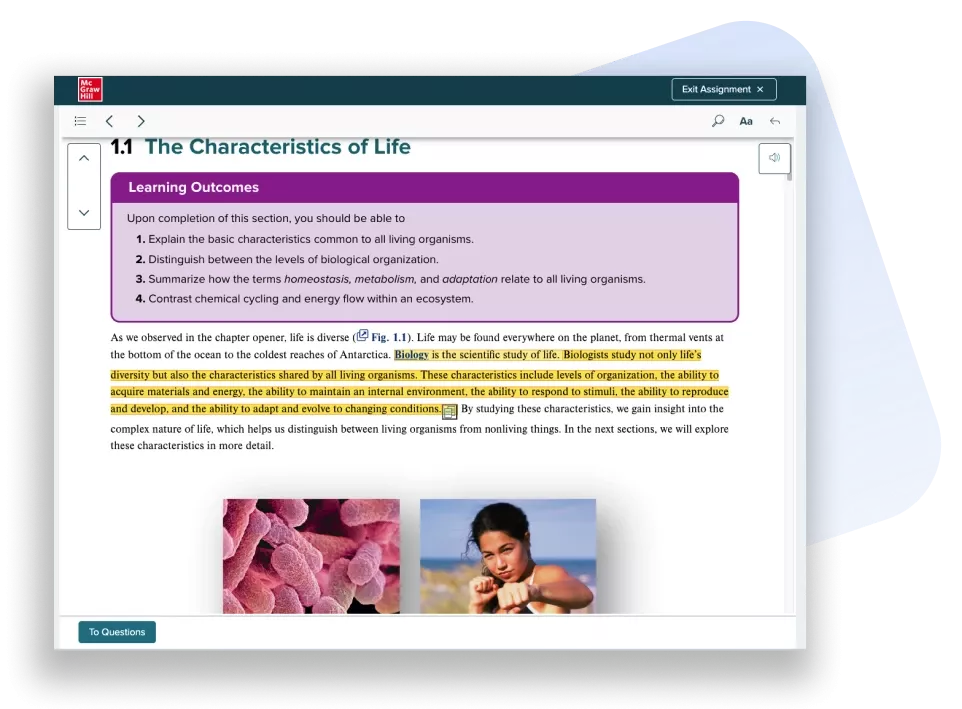
SmartBook 2.0 is an adaptive reading exercise. Read the highlighted parts of the chapter, answer the questions, and rate your level of confidence in each answer.
Your score is how much you have done on your progress bar at the due date, so do as much as possible before that date. Afterward, no more points are awarded, and the assignment moves to Recharge mode, which allows you to continue practicing and receive feedback.
Homework, Practice and Quiz Assignments
These are question-bank assignments that Connect grades automatically. If you can’t do it all in one sitting, use the Save & Exit button to keep your work and then submit it whenever you’re ready. The results are displayed on the Reports tab, and a dash (-) indicates that your instructor has delayed or restricted feedback.
Proctored Tests
Proctored assignments are active only in Google Chrome with certain extensions, and all other browsers are denied access. Prior to the actual test date, students should review the Proctorio system requirements listed by McGraw Hill.
Why Is McGraw Hill Connect So Hard? 5 Reasons Students Struggle
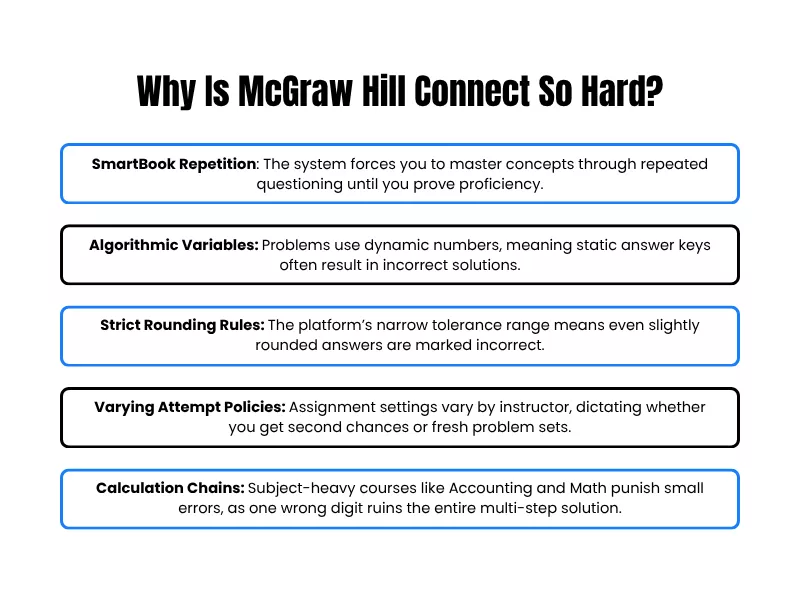
Most McGraw Hill Connect difficulty comes from how the platform is set up, combined with the subject you are taking. Let’s look at some of the common frustrations:
1. Why Does SmartBook Keep Asking Me the Same Questions?
SmartBook will quiz you on concepts that you have not demonstrated understanding of. If you fail on several questions on the same concept, it may take you to a learning resource before you continue.
Because your confidence rating does not affect your progress bar, you should think about what you really know when you rate honestly. No penalty for saying you don’t know.
2. Algorithmic Questions Change the Numbers
Many Connect questions are algorithmic, meaning the values in the problem are not hard-coded but generated by the system; based on the question settings, a new attempt may return a different version. That’s why answer lists extracted from another version/edition rarely correspond.
This is another reason a ready-made McGraw Hill Connect Answer Key rarely helps unless experts tailor it.
3. Why Does McGraw Hill Connect Mark My Answer Wrong When It Looks Right?
Numeric answers are compared to an answer tolerance, which is a small range of acceptable answers, typically prescribed with the question. If your method is correct but you round differently from the instructions, you could get an answer outside the acceptable range.
Before calculating, read the rounding and decimal-place instructions for each question; only round the value you enter; intermediate values should be calculated exactly unless specified.
4. How Many Attempts Do You Get on McGraw Hill Connect Assignments?
This is subjective and depends on the assignment. Instructors can set a limit of one, two, three, or unlimited attempts, and can enforce a percentage penalty for every subsequent attempt.
They also decide whether the new attempt uses the same questions, including the numbers, or starts anew. Some allow study attempts after the due date, but these do not influence your grade.
Manually graded questions remain locked in an assignment until it is marked by your teacher.
5. Which Subjects Are Hardest on McGraw Hill Connect?
There is no difficulty ranking from McGraw Hill, but they tend to be the hardest on Connect if they have long chains of calculations. A typical case is accounting: one transaction may need multiple entries until the total balances out, leading students to search for how to get McGraw Hill Accounting answers.
Depending on the subject matter, the specific challenges vary. Here are some other instances:
- Math/Statistics: Needs precision and strict rounding with multi-step problems.
- Accounting/Finance: Requires correct numbers in lengthy, continuous computations.
- Chemistry: Attention to appropriate use of units, formulas, and significant figures.
- Biology: Makes extensive use of terminology, concepts, and recall.
- Business/Economics: Combines complex calculations and theory-dependent questions.
What Makes a McGraw Hill Connect Assignment Hard?
The challenge of an assignment is also influenced by the way it is structured by your instructor:
- Assignment Rules: Number of questions, total number of attempts, and the severity of time limits.
- Question Design: Algorithmic (randomized) numbers used for each attempt.
- Grading Logic: Whether questions are manually graded or auto-graded, and if the system offers partial credit.
- Available Support: Whether the instructor has turned on any helpful hints or “Check my Work” features.
- Multi-step Complexity: Number of calculation steps needed to get to the final answer.
How Long Does It Take to Finish McGraw Hill Connect Assignments?
There is no typical completion time for McGraw Hill, and any fair estimate will also be based on how your instructor structures the assignments. The amount of time spent on the same chapter in two different courses may vary widely.
Why McGraw Hill Connect Assignments Take Too Long
If you notice McGraw Hill Connect assignments taking too long, SmartBook is the first place to look. It doesn’t end after a fixed number of questions, and missed questions can bring more questions on the same concept. Schedule the first SmartBook and first homework set, and then use those to plan the remainder of the term.